DevSecOps Monitoring
We deliver real-time monitoring of application performance, security events, and infrastructure health — with automated alerting, threat correlation, and incident response playbooks that close the DevSecOps feedback loop around the clock.
End-to-End Monitoring & Observability Services
From application performance metrics to security event correlation — we build full-stack observability platforms that give you complete, real-time visibility into every layer of your system.

Application Performance Monitoring
Deploy distributed tracing, custom metrics, and service-level objective (SLO) dashboards that give your teams real-time visibility into latency, error rates, and throughput across every microservice.

Security Information & Event Management
Centralise and correlate security events from applications, infrastructure, and network layers — using SIEM platforms to detect threats, reduce false positives, and prioritise response with automated severity scoring.

Log Aggregation & Analysis
Collect, centralise, and structure logs from every application, container, and infrastructure component — with full-text search, anomaly detection, and long-term retention for forensic investigation and compliance auditing.
Infrastructure Health Monitoring
Monitor CPU, memory, disk, and network metrics across Kubernetes nodes, VMs, and serverless functions — with capacity planning alerts and auto-scaling triggers that prevent resource exhaustion before it impacts users.

Automated Alerting & Escalation
Design intelligent alerting rules that notify the right team at the right severity — with noise-reduction tuning, on-call routing, and automatic escalation workflows via PagerDuty, Opsgenie, or Slack.

Incident Response Playbooks
Build and automate security and operational incident response playbooks that trigger containment, investigation, and remediation actions automatically — reducing mean time to respond (MTTR) from hours to minutes.
The RND Softech Monitoring Advantage
We build observability platforms that don't just collect data — they surface actionable intelligence, correlate security signals, and close the feedback loop back into your development pipeline automatically.
Full-Stack Visibility
A single observability platform spans application traces, infrastructure metrics, security events, and log streams — giving you complete context for every alert and incident.
Sub-5-Minute Detection
Real-time alerting rules and anomaly detection models identify threats and performance degradations in under five minutes — before they escalate to user-visible incidents.
Automated Response
80% of routine security and operational incidents are automatically contained and resolved by playbooks — freeing your team to focus on complex, high-value investigations.
Closed Feedback Loop
Monitoring insights feed directly back into your CI/CD pipeline — flagging regressions, triggering rollbacks, and informing the next sprint's security backlog automatically.
How We Build Your Observability Platform
A structured approach that moves from instrumentation and collection through to intelligent alerting and automated incident response — all feeding back into the development pipeline.
Instrument & Collect
Applications, infrastructure, and security tools are instrumented to emit structured metrics, traces, and logs into a centralised observability platform.
Correlate & Enrich
Raw signals are enriched with context — deployment metadata, CVE data, and user identity — and correlated across sources to surface meaningful alerts, not noise.
Alert & Escalate
Intelligent alerting rules route notifications to the right on-call team with full context — severity, affected services, and suggested first-response actions included.
Respond & Feed Back
Automated playbooks contain and remediate known incident types. Findings feed back into the CI/CD pipeline and sprint backlog to prevent recurrence.
Frequently Asked Questions
Everything you need to know about our DevSecOps Monitoring & Observability services. Can't find your answer? Talk directly with our specialists.
Monitoring tells you whether predefined conditions are healthy or not — it answers "is something wrong?". Observability goes further — using metrics, logs, and traces together to let you ask arbitrary questions about system behaviour and understand why something is wrong, even for failures you didn't anticipate. Modern DevSecOps requires both.
The three pillars are: Metrics — time-series numerical measurements of system state (CPU, latency, error rate); Logs — structured, timestamped records of discrete events; and Traces — end-to-end records of a request's journey through distributed services. Together they provide complete context for any production issue.
We select tools based on your stack and requirements. Typical choices include: Prometheus and Grafana for metrics and dashboards; the ELK Stack (Elasticsearch, Logstash, Kibana) or Loki for log aggregation; Jaeger or Tempo for distributed tracing; Datadog or Dynatrace for full-stack APM; Falco for runtime security; and Alertmanager, PagerDuty, or Opsgenie for alerting and on-call management.
A Security Information and Event Management (SIEM) platform aggregates and correlates security events from multiple sources — firewalls, identity providers, applications, and infrastructure — to detect threats that individual tools cannot see in isolation. For any organisation with compliance obligations (PCI DSS, ISO 27001, SOC 2) or a meaningful production footprint, a SIEM is essential.
Service Level Objectives (SLOs) define target reliability goals — e.g. 99.9% of requests respond in under 200 ms. Service Level Agreements (SLAs) are contractual commitments based on SLOs. We instrument SLO tracking using error budgets — alerting when budget burn rate is high, enabling teams to prioritise reliability work before an SLA breach occurs.
We address alert fatigue through: symptom-based alerting (alert on user-visible impact, not low-level causes), multi-window burn-rate rules that avoid flapping, alert grouping and deduplication in Alertmanager, automated inhibition rules that suppress child alerts when a parent fires, and regular alert review sessions to retire stale or low-value rules.
Distributed tracing follows a single request as it travels through multiple microservices — recording the time spent at each hop, errors encountered, and database queries executed. It is essential for diagnosing latency and error issues in microservices architectures where a single user request may touch dozens of services, making it impossible to diagnose problems from metrics or logs alone.
Playbooks are defined as code — using tools like PagerDuty Runbook Automation, Rundeck, or custom webhook-triggered scripts — that execute predefined remediation steps automatically when specific alert conditions are met. Common automations include: restarting crashed pods, scaling up under-resourced services, blocking suspicious IP addresses, revoking compromised credentials, and creating ITSM incident tickets.
Monitoring closes the DevSecOps feedback loop by feeding production signals back into the pipeline. Post-deploy health checks query monitoring APIs to verify SLO compliance before a canary release progresses. Anomaly detection can trigger automated rollbacks. Security findings from runtime tools (Falco, SIEM) automatically create tickets in the sprint backlog for developer remediation.
We build monitoring solutions for AWS (CloudWatch, Security Hub, GuardDuty), Microsoft Azure (Monitor, Sentinel, Defender for Cloud), Google Cloud (Cloud Monitoring, Security Command Center), and multi-cloud environments using a vendor-agnostic stack (Prometheus, Grafana, ELK, OpenTelemetry) that provides consistent visibility regardless of where workloads run.
Retention periods are configured to meet your compliance framework requirements — typically 90 days hot storage plus 1–7 years cold archival. PCI DSS requires 12 months of audit log retention; HIPAA requires 6 years. We implement tiered storage strategies (hot/warm/cold) using S3 Glacier, Azure Archive, or GCS Coldline to balance retention requirements with cost.
OpenTelemetry (OTel) is the CNCF standard for instrumenting applications — providing vendor-neutral SDKs and collectors for metrics, logs, and traces. Adopting OTel means your instrumentation is portable across any backend (Grafana, Datadog, Jaeger, etc.) and you avoid vendor lock-in. We recommend OTel as the default instrumentation standard for all new projects and existing services where migration is feasible.
We deploy the kube-prometheus-stack (Prometheus Operator, Grafana, Alertmanager) for cluster-wide metrics — covering node resource usage, pod restarts, HPA scaling events, and API server health. Loki collects container logs. Falco monitors runtime syscalls. Kube-bench continuously validates CIS benchmark compliance. All dashboards are pre-built and available from day one.
Yes. Legacy systems can be monitored using agent-based collection (Prometheus node_exporter, Elastic Agent, Telegraf) without requiring application code changes. For systems that only produce syslog or Windows Event Log output, we configure log shippers (Filebeat, Fluentd) to forward events to the centralised platform. Even mainframe and legacy database systems can be integrated via JDBC metrics exporters and log forwarders.
We begin with a monitoring maturity assessment — reviewing your current tooling, alert rules, on-call processes, and coverage gaps. Week 1 delivers a platform architecture proposal and quick wins (deploying core dashboards and reducing top 10 most noisy alerts). Subsequent sprints progressively expand coverage, implement SIEM correlation rules, and automate incident response playbooks — with full runbook documentation and team training throughout.
Ready to Get Full-Stack Visibility?
Let our specialists build a monitoring and observability platform that surfaces real threats, eliminates alert noise, and feeds intelligence back into your pipeline — so your team ships safer software every sprint.
Our Certifications
RND Softech maintains the highest standards of security, quality, and compliance with globally recognized certifications across all operations.
Have a Project in Mind? Let's Talk
Use our contact form for all information requests or contact us directly. All information is treated with complete confidentiality.

.webp)
Talk to Our Experts
Schedule your free consultation
More Than 250+ Clients Worldwide Work With Us
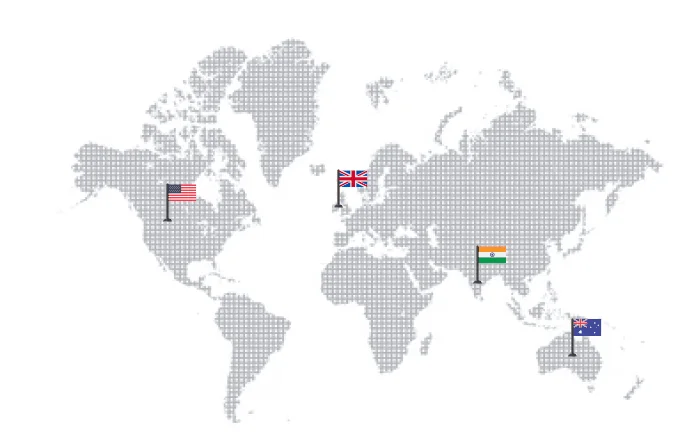
With a presence across 4 continents, we deliver exceptional back-office staffing solutions to businesses in USA, UK, Canada, and Australia.